Create a formatted heatmap from PubMatrix results
Source:R/heatmap_functions.R
plot_pubmatrix_heatmap.RdThis function creates a heatmap displaying overlap percentages derived from a PubMatrix result matrix, with Euclidean distance clustering for rows and columns.
Usage
plot_pubmatrix_heatmap(
  matrix,
  values = c("raw", "row_pct", "relative"),
  title = "PubMatrix Co-occurrence Heatmap",
  cluster_rows = TRUE,
  cluster_cols = TRUE,
  show_numbers = TRUE,
  color_palette = NULL,
  filename = NULL,
  width = 10,
  height = 8,
  cellwidth = NA,
  cellheight = NA,
  scale_font = TRUE
)
Arguments
- matrix
A data frame or matrix from PubMatrix results containing publication co-occurrence counts
- values
Character scalar selecting what is plotted in each cell. One of `"raw"` (default, the co-occurrence counts as returned by [PubMatrix()]), `"row_pct"` (each cell as a percentage of its row total), or `"relative"` (see Details).
- title
Character string for the heatmap title. Default is "PubMatrix Co-occurrence Heatmap"
- cluster_rows
Logical value determining if rows should be clustered using Euclidean distance. Default is TRUE
- cluster_cols
Logical value determining if columns should be clustered using Euclidean distance. Default is TRUE
- show_numbers
Logical value determining if overlap percentage values should be displayed in cells. Default is TRUE
- color_palette
Color palette for the heatmap. Default uses a red gradient color scale
- filename
Optional filename to save the heatmap. If NULL, displays the plot
- width
Width of saved plot in inches. Default is 10
- height
Height of saved plot in inches. Default is 8
- cellwidth
Optional numeric cell width for pheatmap (in pixels). Default `NA` lets pheatmap auto-size.
- cellheight
Optional numeric cell height for pheatmap (in pixels). Default `NA` lets pheatmap auto-size.
- scale_font
Logical value determining if font size should scale with cell size. Default is TRUE
Value
A pheatmap object (invisible). The matrix actually plotted is attached as the `"plotted_values"` attribute.
Details
Rows and columns are clustered with Euclidean distance. NA values in the input matrix are converted to 0 before any calculation.
The `values` argument controls what each cell shows:
`"raw"` (default) - the co-occurrence counts themselves.
`"row_pct"` - each count as a percentage of its row total, useful for comparing how one row's attention is distributed across columns.
`"relative"` - `count / (row_total + col_total - count) * 100`, where the totals are sums over the supplied matrix.
Note that `"relative"` is **not** a Jaccard index and is **not comparable across runs**. Its totals are sums over whichever partner terms happen to be in the matrix, not the marginal publication counts for each term, so adding an unrelated term changes the value reported for every existing cell. A true Jaccard index would require the single-term counts, which [PubMatrix()] does not fetch. Use it only to compare cells within one fixed matrix.
Examples
# Create a small test matrix
test_matrix <- matrix(c(1, 2, 3, 4), nrow = 2, ncol = 2)
rownames(test_matrix) <- c("Gene1", "Gene2")
colnames(test_matrix) <- c("GeneA", "GeneB")
# Create heatmap using the helper (plots the raw counts by default)
plot_pubmatrix_heatmap(test_matrix, title = "Test Heatmap")
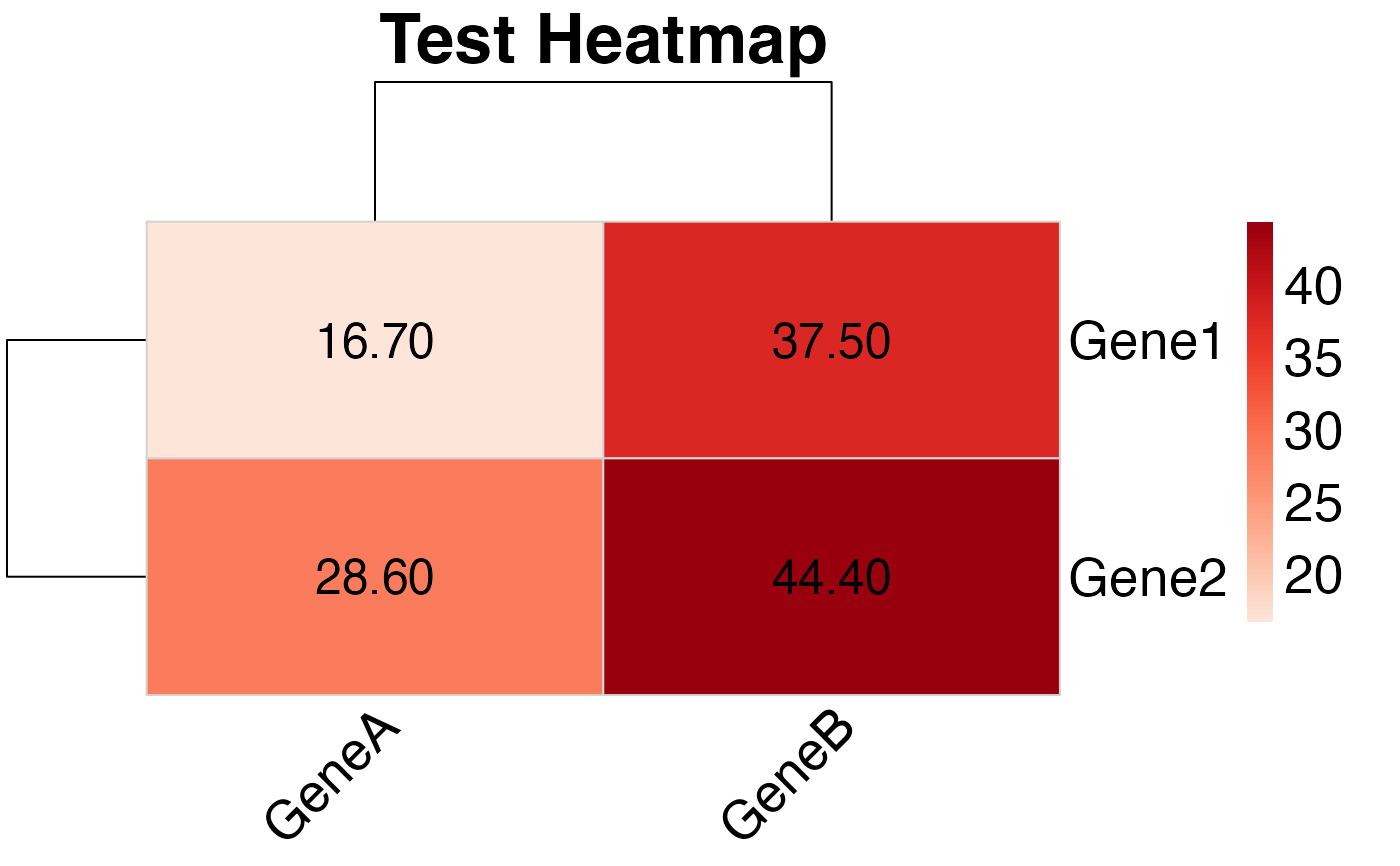 # Percentage views are available too:
plot_pubmatrix_heatmap(test_matrix, values = "row_pct", title = "Row %")
# Percentage views are available too:
plot_pubmatrix_heatmap(test_matrix, values = "row_pct", title = "Row %")
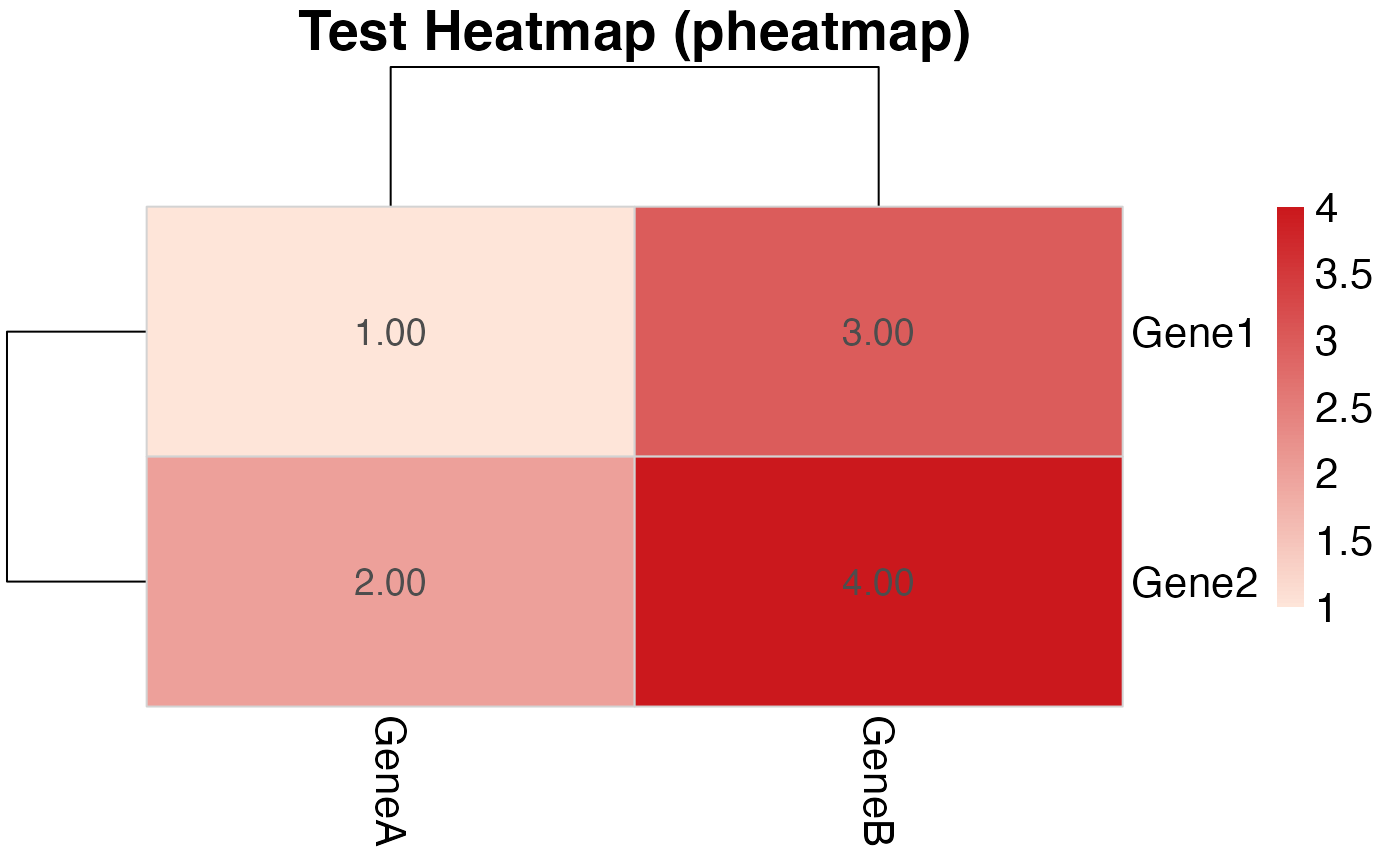
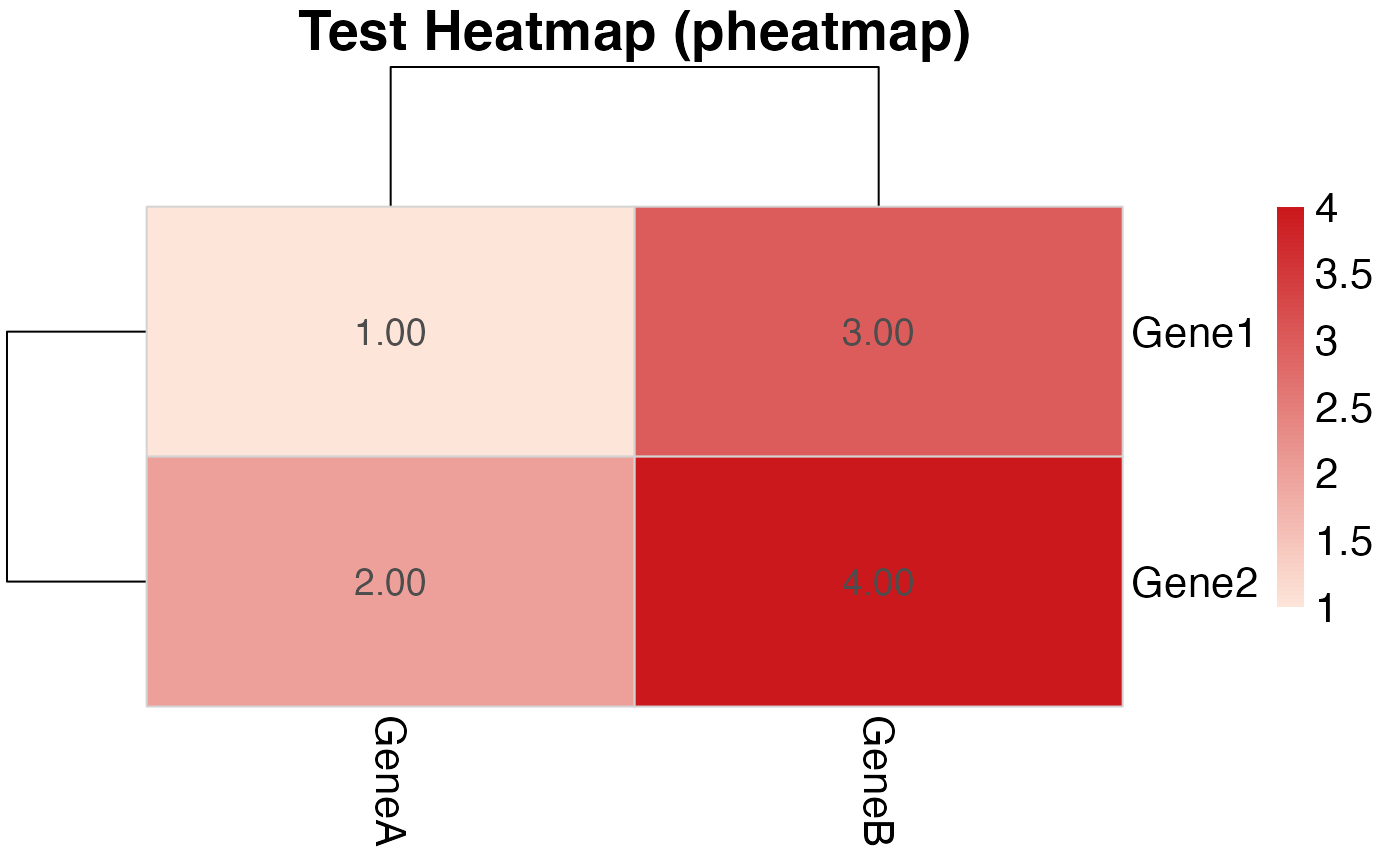 # Equivalent using pheatmap directly:
pheatmap::pheatmap(
test_matrix,
main = "Test Heatmap (pheatmap)",
color = colorRampPalette(c("#fee5d9", "#cb181d"))(100),
display_numbers = TRUE,
fontsize = 16,
fontsize_number = 14,
border_color = "lightgray",
show_rownames = TRUE,
show_colnames = TRUE
)
# Equivalent using pheatmap directly:
pheatmap::pheatmap(
test_matrix,
main = "Test Heatmap (pheatmap)",
color = colorRampPalette(c("#fee5d9", "#cb181d"))(100),
display_numbers = TRUE,
fontsize = 16,
fontsize_number = 14,
border_color = "lightgray",
show_rownames = TRUE,
show_colnames = TRUE
)